Market’s back, but people aren’t

Dow high
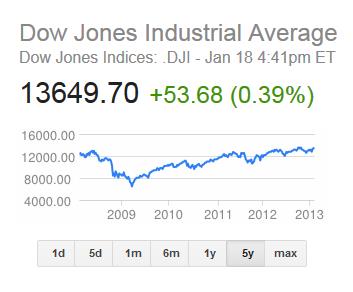
The Dow hit its highest point since December 2007 this week. (Image: Google)

By Daniel Wilcock

The American stock market, as measured by both the Dow Jones Industrial Average and the S&P 500, closed yesterday at its highest level since December 2007.

Ordinarily, as a low-cost index investor, I agree with market sages such as Burton Malkiel and John Bogle, who caution investors not to pay much attention to the daily soap opera of market fluctuations. But somehow this particular milestone means something to me.

In April of 2008, I relocated to the States from Japan, where I’d been living the previous two years. Luckily, I found a nice writing job at Georgetown University (a relatively safe harbor within stormy seas) shortly before the markets went to hell and employers started shedding their payrolls. When the Lehman collapse happened, I can clearly recall the indexes going down 5% each day for several consecutive days.

Those dark days always made me flash back to the summer of 2007, when my wife and I took a honeymoon in Finland and Denmark. Each day, I had the luxury of perusing the International Herald Tribune in a leisurely way. That splendid summer, the financial news was filled with warnings of a coming market catastrophe, evidenced by the failure of some mortgage-related funds at Bear Stearns.  Yet the market continued to go up in the following weeks.

We may be approaching a conclusion to those days of frozen credit and a hemorrhaging housing market. In my opinion (which I admit is quite different from Wall Street types), The Consumer Financial Protection Bureau is leading our housing and credit economies to a brighter future. In this regard America may be learning something from Canada, which didn’t have a mortgage crisis.

But what about the 8% of workers in America and more than 50% of young people in countries like Spain who wish to enter the workforce, but can’t find their way? I’m looking for ways to be optimistic about the future of labor in the new era we’ve entered. B corporations and the GIIRS index inspire me, as do companies and organizations that take environmental and community sustainability seriously.

The market’s return is an indicator of our collective wealth. The unemployment problem is an indicator of our collective poverty. My hope is that our markets will evolve and bring their productivity to bear on the social and environmental problems we face.

Idealistic, yes. Naive, perhaps. But optimists live better lives.
‘Baseball’ by George Vecsey

Babe Ruth
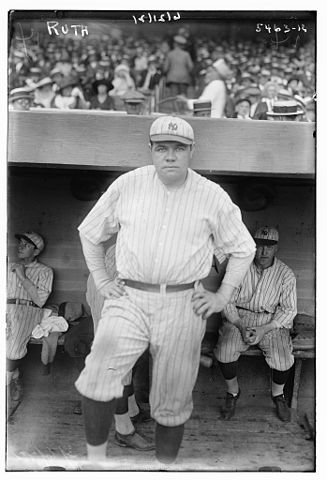
Babe Ruth, baseball’s savior (Library of Congress via Wikimedia Commons)

By Daniel Wilcock

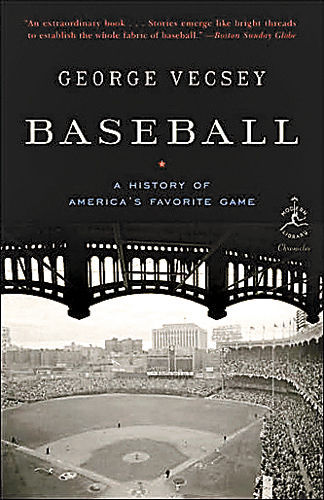
Book review: ‘Baseball: A History of America’s Favorite Game’ George Vecsey  (2006, Modern Library, $14)

“Brevity is the soul of wit”—William Shakespeare

A simple idea runs through much of literary history: concise writing is harder, but better. Attributed to a wide range of writers, from Cicero to Mark Twain, this concept is best exemplified by Lincoln’s Gettysburg address.

For the last few decades, baseball has inspired a steady stream of 700-page tomes, many of which focus exhaustively on a single player or season. George Vecsey’s 2006 book Baseball boils the lot down to a scant 200-some-odd page collection of editorial-style vignettes.

Vecsey, a New York Times columnist, doesn’t hide his opinions. He grew up a Brooklyn Dodgers fan, though he adores their nemesis Stan ‘The Man’ Musial—about whom he recently wrote a 400-page biography. He considers the steroid-ball of the 90s and early 00s a catastrophe, but still has admires grudgingly the villains (erstwhile heroes) of the era.

Baseball
Baseball by George Vecsey

Despite his love for the Brooklyn Dodgers and Musial, it’s Babe Ruth who for Vecsey personifies baseball. Here’s part of his paean to the Great Bambino:

 “Babe Ruth saved baseball—and saves it still, truth be told. With Barry Bonds and other latter-day sluggers permanently tainted by steroid suspicions, the good old Babe looks better and better.

Ruth was not only the greatest player in the history of the game but he was also a rollicking, likable, outsized character who arrived at precisely the right moment. He dominated the nation during a decade devoted to change (women gained the right to vote in 1920) and avoidance (Prohibition was enacted that very same year, and promptly bypassed by a huge swath of the country). Who better to personify this coming-of-age decade, the Roaring Twenties, than a barrel-chested, pigeon-toed hedonist known as the Babe.”

If you like the above passage, its commentary rendered elegantly from a 10,000-foot vantage point, you’ll probably like the rest of the book. I certainly did. Just as the Gettysburg Address stood in contrast to the two-hour oration that preceded it, this short book is a keeper among baseball books.

I say it each winter: Can’t wait until April.