The iPhone was designed to be kept in a front pocket. Harder to lose a $600 computer when it’s screen in, speakers up, left pocket (for non-southpaws like me).
Last month I learned this the hard way when I lost track of my iPhone 5. As a result, I’m a slave to Verizon for 2 more years.
This blog post is being composed on my replacement phone, which will promptly be returned screen in, speakers up, left pocket.
Blogging on a phone is tough. I’ve been fighting with autocorrect all the way.
Recently I’ve been taking a massive open online course (MOOC) from Harvard via EdX. The course, called Justice, is a compact primer on the major philosophies that frame contemporary ethics.
The idea to take the class came from a New York Times column that identified Justice as EDX’s first humanities course. As a lifelong learner and believer in the value of a liberal arts education, I figured I’d give it a shot.
The instructor, Michael Sandel, strikes me as an ideal instructor for exposing hundreds of thousands of people to thinkers like Bentham and Kant. He delivers his lectures with precision and, as far as I can tell, rises above offering any opinion himself. The class itself is pretty simple: lecture videos and required quizzes with some optional forums and reading links thrown into the mix.
It’s been a pleasant way to pursue some extra-curricular education. Yet right now I think MOOCs are closer in value to checking out a stack of books from the library than being a member of a scholarly community.
Unless MOOCs become substantially more interactive, shifting the work of universities to the equivalent of advanced online customer service, I don’t think they spell the end of higher ed. They are simply too passive. In a world in which access to information is becoming rapidly democratized, the kind of information that MOOCs provide is becoming cheaper than ever. If technology puts that information at your command whenever you need it, the utility of having slogged through a ton of online lectures may be marginal at best.
Rather than being a harbinger of doom, I think MOOCs will force universities to offer a better value to students. Far too many families have paid far too much money in America for information-dump classes. I hope that universities begin to use MOOCs so students can get these preliminaries out of the way. Classroom time can be reserved for the good stuff: sharing a journey with an expert guide, learning the essential interpersonal art of persuasion, exposure to the idiosyncrasies of peers, testing and revising one’s ideas through debate, working on teams and contemplating lessons in daily life.
I know this may sound overly idealistic, perhaps credulous. I realize that college is also a place where young people go off to over-priced summer camp characterized by climbing walls and bad beer in red cups. MOOCs won’t change who 20somethings are, but hopefully they’ll inspire universities to be a bit better.
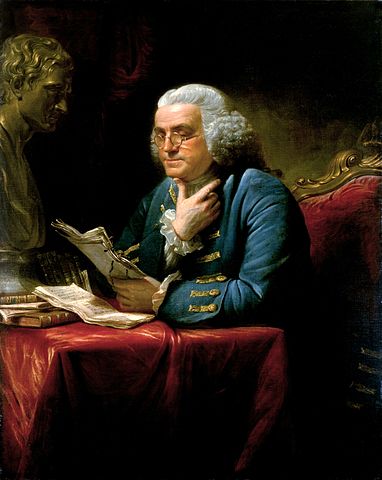
Benjamin Franklin with the expression he might have worn when he wrote of croakers (image: Wikimedia Commons)
By Dan Wilcock
I can only imagine the expression Benjamin Franklin wore when he wrote the delightful passage below in his autobiography. My guess is that he either sported a lopsided grin or pursed lips and twinkling eyes. At any rate, as with the best parts of the autobiography, Franklin’s discourse on “croakers” is a hoot that nonetheless contains some very sage advice.
“There are croakers in every country, always boding its ruin. Such a one then lived in Philadelphia-a person of note, an elderly man, with a wise look and a very grave manner of speaking; his name was Samuel Mickle. This gentleman, a stranger to me, stopt one day at my door, and asked me if I was the young man who had lately opened a new printing-house. Being answered in the affirmative, he said he was sorry for me, because it was an expensive undertaking, and the expense would be lost; for Philadelphia was a sinking place, the people already half bankrupts, or near being so; all appearances to the contrary, such as new buildings and the rise of rents, being to his certain knowledge fallacious, for they were, in fact, among the things that would soon ruin us. And he gave me such a detail of misfortunes now existing, or that were soon to exist, that he left me half melancholy. Had I known him before I engaged in this business, probably I never should have done it. This man continued to live in this decaying place, and to declaim in the same strain, refusing for many years to buy a house there, because all was going to destruction; and at last I had the pleasure of seeing him give five times as much for one as he might have bought it for when he first began his croaking.”
My translation: doomsday is overrated. We can always see it coming if we look for it. For a budding entrepreneur, as Franklin was at this stage of his life, croakers aren’t the best people with whom to hang around. Their “certain knowledge” of our “sinking” state of affairs and impeding ruin foster the wrong mindset.
I don’t think Franklin is advising that we discount risks. He’s no fool. Rather, I think he’s saying that focusing exclusively on risks may be the biggest risk of all. The moral of the story can be seen when the croaker forks over five times what we would have for a house if he hadn’t believed that Philadelphia of the 1700s “was a sinking place.”
I think we can forgive Franklin for the schadenfreude he displays here. The cheery sagacity with which he tells this tale makes it a classic.
 Trails and Talismans