Dean Kamen (video screenshot from Time.com) holds 440 patents and is on a quest to solve the world’s largest health problem: lack of access to clean water
By Dan Wilcock
Dean Kamen, founder of DEKA Research and Development, holder of 440 patents, inventor of the Segway, and member of the National Inventors Hall of Fame, thinks deeply about invention and what it takes to be an inventor. He shared these gems at the Time Future of Invention forum held at the Newseum in Washington, DC, Nov. 21, 2013.
“Government plays a critical role in invention at the highest level of abstraction. They fund public education. Without tools, it’s pretty hard to turn some great abstract idea into reality. If you don’t have a little math, and a little physics, and a little electrical engineering, you can have great ideas, but they are just ideas.”
“Teaching is sort of the antithesis of inventing because teaching is all about analysis. They teach you how to break something down based on the experience of people before you. That’s how you learned algebra and trigonometry, with the answers in the back of the book. You’re learning what people have done, what’s in the past. So you’re learning what’s here. Invention is not analysis, breaking things down. Invention is synthesis. It’s putting things together in a way they were never put together before. You rarely get to do that in school. In fact, when you do it the way it was never done before you get an F.”
“You probably remember the story of David and Goliath. As a little kid, I heard that story and maybe it proves I was born a geek because the moral of that story…is that technology is cool.” (In reference to the Slingshot water purifier, on which DEKA will partner with Coca-Cola to bring clean water to villages around the world)
“Ultimately, inventing is not a committee activity.”
“Inventing is seeing the same problem that everyone around the world is seeing, but looking at it differently.”
“If we don’t redouble our efforts to increase incentives for invention, this country’s going to lose its edge.”
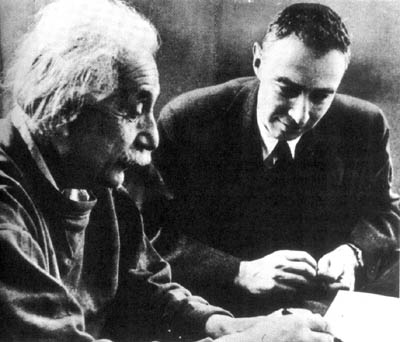
Robert Oppenheimer (right), who famously declared “Here’s your damn organization chart,” while working on the Manhattan Project, may not have been the best project manager, but at least he got to hang out with Einstein (Image: Wikimedia Commons)
By Dan Wilcock
The modern concept of project management, the art and science of ‘getting it done,’ sprang to life in the 1940s with the $2 billion Manhattan Project. Since then, project management has grabbed an increasing share of mankind’s activity. Sometimes projects are executed superbly, and tend to be taken for granted; others get derailed disastrously—as the headlines about healthcare.gov attest and anyone familiar with the Silver Spring Transit Center will tell you.
Here are a handful of facts about project management that PM novices (like me) might find surprising:
1) A quarter of the earth’s gross domestic product gets spent each year on projects of all kinds according to the Project Management Institute (PMI)*. That’s 18 trillion USD using the 2012 World Bank global GDP estimate. In terms of the animal kingdom, that puts us humans on par with beavers for project-focus.
2) The ranks of professional project managers are growing explosively. Back in 1993, there were only around 1000 certified Project Management Professionals (PMP). By 2011 there were 467,000. Globally more than 16 million people call themselves project managers. Fewer than half of U.S. companies had a project management office in 2000, and now more than 80 percent do.*
Like beavers, we humans tend to focus on projects (Image: Wikimedia Commons)
3) Project management success rates resemble batting averages in baseball. For IT project management, the best work tracking this phenomenon is done by the Standish Group, which produces the CHAOS report, the first iteration of which found that only 16.2 percent* of IT projects succeeded. Things have improved since then with the rise of project management science. Still, more than half the time, PMs cannot balance the “triple constraint” of scope, time, and cost. Incidentally, the Standish Group has some wise thoughts about the healthcare.gov debacle on their blog.
4) Sometimes projects are delivered within the triple constraint, but the deliverables get scrapped anyway. The $34 million Camp Leatherneck in Afghanistan made headlines this summer when it was completed. Three years ago a general tried to stop construction of what was to become the “Taj Mahal” of US command centers, reportedly saying “I don’t want it, don’t build it, I won’t use it. So stop construction,” but the project continued regardless. Neither the US nor the Afghan military plan to use the base as intended.
5) Even for the experts, it’s hard to maintain success rates and quality. An internal audit at the World Bank found that performance on projects such as roads and schools has been declining for a decade despite amplified investments to counter the global financial crisis.
In other words, if you work with a project manager or a PM team, and they are delivering the goods as specified, on time, and as budgeted, respect is due.
*Schwalbe, K. Information Technology Project Management, 7e
The word heuristic, which refers to applying a rule of thumb (often based on experience) to interpreting information that can allow you to come to quick conclusions, is red-hot in the marketplace of words. When I looked it up on m-w.com, a pop-up proclaimed that “Heuristic is currently in the top 1% of lookups and is the 172nd most popular word…a green arrow indicates a fast mover: this word increased significantly in lookups over the past seven days.”
Part of the reason for the word’s trendiness can be attributed to Daniel Kahneman’s Thinking Fast and Slow, the Nobel-prize winning psychologist’s 2011 bestseller that presents his theory about how the mind works on two levels, one fast, intuitive, and emotional, the other slow and deliberative. I’ve only begun reading it, but am already spellbound. Kahneman is one of the world’s foremost thinkers on heuristics. He uses the word as a noun (it’s also an adjective), though it strikes me that this is just a kind of shorthand that people working around this word have developed to avoid having to type “heuristic approach” over and over.
Beyond Kahneman, I think the word’s appeal today is that it’s a suitably academic word that sounds a heck of a lot better than other nouns that can be used to mean the same or similar things, such as: “cheat,” “life-hack,” etc. It’s also popular because heuristics themselves are in demand. In our increasingly complex, big-data-driven lives, heuristics offer a way to avoid doing all of the number-crunching. Recently an index card that distills a reasonable personal finance strategy onto a 4×6 index card went viral. When I read the card, I agreed with everything on it—I had already subscribed to all of the heuristics.
I’ll post about Kahneman’s take on heuristics later, after I’ve read the book. Something tells me that while they are super useful, they may also blind us as well.
Like most people in rich counties, I find myself all too often falling into the trap of thinking that identity can be purchased. I could be wrong, but it seems to me that this mistaken belief is the source of endless fool’s errands. Life isn’t necessarily made more authentic by acquiring this and that. If anything, the acquired thing (whatever it happens to be–clothing, entertainment, etc.) has no influence on character. Most of the time, especially for the fortunate, the thing in question is something we already have. This confirms that the thing in question is just a temporary mental fixation. These fixations are an easy escape from a thornier mental issue–the quest for identity. Many Mahayana Buddhists believe that identity is an illusion, that it blinds us to the reality of our interconnectedness. That may well be so. But for day to day life, simpler ideas will suffice. “I already have one,” when true, are some of the most powerful words we can speak. By not filling the container to the top, we can leave space for living.
Metrorail hasn’t changed much since ’76. But some long overdue updates are coming. Image: Wikimedia Commons
By Daniel Wilcock
Like me, Washington DC’s Metrorail subway system was born in 1976. Also like me, it is starting to show its age. This was never clearer than in the June 2009 Fort Totten train collision that killed 9 people, injured 80 and kept passengers trapped for hours. Since then the system has been a joke by international standards, with single-tracking and multiple station closures common—especially over weekends.
Decades of delayed maintenance due to the chronic underfunding driven by the system’s fractured governance have finally caught up. The endless outages have settled over the city like a rain cloud that never leaves. Blogs like Unsuck DC Metro have gained big followings by serving as a conduit for rider rage. It’s been so bad for so long that any positive stories about the system are liable to be held forth for universal ridicule.
But in a sneaky way, a lot of nifty improvements are cresting on the horizon. Here are three reasons for cautious optimism:
1) The silver line will be an equal partner to the old-school color lines (orange, blue, red, green, and yellow). When the Washington Post published the new system map this week, designed by Lance Wyman, the same man who designed the original map 37 years ago, I was relieved to see the silver line shooting all the way through town. Previous maps had the line ending at East Falls Church, raising the annoying prospect of needing to transfer to get downtown in an encumbered and jet-lagged state after touching down at Dulles Airport.
2) The new rail cars will be made by Kawasaki, a Japanese company. Having lived in Japan, I can attest to the quality of Japanese rail systems. The 1976 models designed by an Italian firm, still in use, will one day be a topic for nostalgia. However, I don’t think they’ll be missed. The prototype from two years ago of the 7000-series, which will replace more than half of the system’s cars within the next five years, pointed to some cool features such as video panels. When these cars start to roll out, I’m certain that folks will notice the almost-four-decade design difference. At the very least, the new cars promise to not have such consistent air conditioning problems.
3) You’ll be able to pay your fare using a smartphone. Buried in a recent Post article was the following bit of news:
“[Metro’s General Manager Richard] Sarles said the agency also had decided to buy new fare gates that will allow riders to pay as they enter with a SmarTrip card, a credit card or a smartphone. The stainless steel gates will be installed throughout the Metrorail system and will replace the 1970s-era gates. Riders should begin seeing the new fare gates next year, officials said.”
This is the logical evolution of Metrorail’s SmarTrip card system, reducing the need for smartphone owners to carry around yet another plastic card.
In other metro news: SmarTrip cards are getting cheaper, and, within the next few months Metro will put its trains back on autopilot (they’ve been operated manually since the 2009 accident, with resultant choppy service).
In 2008, the banking system of Iceland systematically failed, which led to a financial crisis from which the Nordic European island country is still recovering.
What does this have to do with cloud computing?
Iceland got rich temporarily through high finance, but it was boom and bust. In the aftermath of this painful episode, this island comprised mostly of a “cold and uninhabitable combination of sand, mountains and lava fields,” must find a sustainable economic growth alternative.
Cloud computing can be that alternative. Consider:
Data centers require a lot of energy, but Iceland has a steady supply of thermal energy—enough to power the centers entirely through natural energy.
Data centers use less energy when the ambient temperature is lower and Iceland’s name says it all. The year-round climate is chilly. Combined with the steady energy supply, those cooler temperatures ensure further energy efficiency.
For security and risk mitigation reasons, data centers are best situated in sparsely populated areas. Iceland is one of the world most sparsely populated countries.
A Rapidly Expanding Market
According to the technology research company Gartner, the market size of public cloud services in 2013 is $131 billion and its 2013 growth rate will be 18%. The same study found infrastructure as a service as (IaaS) the fastest-growing component of the cloud market. IaaS grew 42.4 percent in 2012 to $6.1 billion. This year the increase is predicted to be 47.3 percent.
Cloud computing, particularly IaaS, represents a good opportunity for return on capital invested by any entity. Yet Iceland has significant advantages that would make its return on investment greater than competitors in other counties. Those advantages are natural geothermal energy and an environment conducive to both greater efficacy and better security, factors described below.
Cloud computing is also a better alternative than the recent explosion of aluminum smelter operations in Iceland—an industry that already consumes five-times the amount of electricity as Iceland’s residents. As the financial crisis taught, over-reliance on one industry creates significant risk. Cloud computing can be a balancing factor that will reduce this risk.
Solving Cloud Computing’s Energy Crisis
Not only would Iceland’s economy benefit from a major investment in cloud computing, the cloud computing market would benefit greatly. This is because the data centers that make cloud computing possible use vast quantities of electricity. By one estimate, a typical server farm uses the same amount of power as 180,000 homes. Iceland’s historic investment in capturing geothermal energy has paid tremendous dividends. Currently 25% of electricity usage in Iceland is from geothermal, with almost all of the balance coming from hydro-power. This gives data center operations in Iceland four distinct energy advantages:
Abundant, cheap power
Green power
Power derived from a source unlikely to fail suddenly
Cooler ambient temperatures that reduce the need to use power to cool servers, making data centers more efficient
If the data revolution continues to grow exponentially within a context of worsening global environmental problems such as climate change, companies around the world will be under pressure to find eco-friendly solutions for cloud computing. Some companies are already showing the way in Iceland. An Icelandic startup called Greenqloud offers a “sustainable public compute cloud that is 100% carbon neutral.” They have been joined by Verne Global, a British company that offers similar 100% renewable-energy services.
Yet one big potential disadvantage to making Iceland “cloudland” must be mentioned: Iceland’s abundant geothermal power comes from the island’s volcanic character. A major eruption could wipe out one or more centers. This risk can be mitigated by locating all data centers in areas far from the ridges on which Iceland’s volcanos rise and seeking protective land formations that would shield from lava flows such as natural or man-made caves.
In the past Iceland has been the victim of its unforgiving geography, which is not conducive to farming or dense population. The era of big data could flip this reality, making Iceland’s low temperatures and abundant natural energy the nation’s signature assets.
A review of Jaron Lanier’s Who Owns the Future? (2013) Simon & Schuster
By Dan Wilcock
In early 2013, IBM made the mind-boggling claim that 90% of the data in the world had been created in the previous two years alone. Facebook, which crested one billion users in October 2012, is but one of many platforms elevating Big Data’s exponential growth curve.
Big Data—the vast digital Sahara of trillions of aggregated binary-code sand grains—may well be this century’s fulcrum of wealth and power. The data centers that comprise “the cloud” are now arguably as central to global commerce and security as the hubs of the petroleum industry. The recent revelations about NSA internet surveillance are further confirmation that a new era has dawned.
And no matter how many people unplug their Facebook accounts, as I did shortly after reading Who Owns the Future?, we can’t go back to a pre-networked world. Short of some kind of unwanted cataclysm that knocks us off our current course, the momentum is just too strong. New developments in networking, such as the ‘internet of things’ which harnesses data and internet connectivity to make our cars, homes, and appliances ‘smarter,’ portend almost limitless network growth.
Nor can we erase the data we’ve already created. “The option to ‘delete’ data is largely an illusion,” write Google executives Eric Schmidt and Jared Cohen in their book The New Digital Age, published less than two weeks before Who Owns the Future?
Lanier’s bookpresents a caustic but indispensable minority report to such Silicon Valley triumph literature. It takes companies like Google and Facebook to task for driving a new economic order in which wealth and power are consolidated where entrepreneurs, the best computers, and best computer scientists converge to harvest Dig Data. The list of industries being disrupted grows each day.
As a minority report, it also sketches an alternative vision of new economic system in which individuals get paid for the data they generate. There are some problems with this idea, which I’ll detail below, but his aim is respectable. He wants ordinary people to survive and thrive in the new era. He calls himself a “humanist softie,” which I think is an admirable position to take.
The Rise of the Siren Servers
This moment of ascendant power has long been the dream of technology companies. Lanier identifies himself as someone who helped build today’s commercial and academic internets. The dust jacket calls him a co-creator of “start-ups that are now part of Oracle, Adobe, and Google: and the recipient of a lifetime career award from the Institute of Electrical and Electronics Engineers.
Lanier writes about how the progressive vision of a humanistic digital economy imagined by internet pioneers such as Ted Nelson, whose writings in the 1960s presaged today’s digital sharing and the use of hyperlinks, has been clouded by the rise of what he calls “siren servers.” These he defines as: “an elite computer, or coordinated collection of computers, on a network. It is characterized by narcissism, hyperamplified risk aversion, and extreme information asymmetry.”
He puts this in slightly simpler terms in the following paragraph:
Siren servers gather data from the network, often without having to pay for it. The data is analyzed using the most powerful available computers, run by the very best available technical people. The results of the analyses are kept secret, but are used to manipulate the rest of the world to advantage.
To what advantage do today’s tech giants slice and dice our data? Riches for company founders and an increasing pile of advertising revenue from companies vying to grab more market share. For companies, the servers offer the ability to get precise and immediate feedback on customers, to whom they sell products and services more efficiently (with fewer employees). For government security agencies, the analysis yields a gold mine of previously-unavailable mission-critical information about threats.
In addition to being a computer scientist and author, Jaron Lanier is also a musician who plays rare instruments (Image: Wikimedia Commons)
Who Could Argue with “Free?”
Big Data is provided to siren servers “for free” because users get a “free service” in return. Google brings us to the information we need faster. Facebook gives us a window into the unfurling lives of remote family and friends. Skype allows us to video chat without paying them, and thus we can save hundreds of dollars in international long-distance charges in the process.
The word free above is placed in quotations because the exchanging information for a service means the service isn’t really free. The fact that something is provided without cost usually just means that you, as the user, are not the customer. You are the product. You are being sold. The implication from Lanier’s book is that you are increasingly being ripped off.
He points to musicians who now have to sing for their supper each night because they no longer can rely on support from labels and translators whose works get fed into online translation engines without consent. Technology and the lure of free content make it tough for some folks to make a living these days, and Lanier argues that the ranks of such people will continue to grow as servers advance in developing artificial intelligence.
Lanier doesn’t bring them up, but the infamous instant messages sent by Mark Zuckerberg to a friend that describe Facebook’s early users as “dumb fu*ks,” for trusting him with their information confirms the suspicion that the mega servers are conceptually designed to rip people off. But Lanier doesn’t spend time blaming the owners of siren servers for taking their opportunities:
And it’s not Facebook’s fault! We, the idealists, insisted that information be demonetized online, which meant that services about information, instead of the information itself, would be the main profit centers.
Instead of people getting paid, they get pumped for data for which, by express consent in the user agreements that everyone signs without reading, they are blocked from seeking payment. Lanier writes:
Even the most ambitious outcomes in the most fabulous futures articulated in the moneyed dreamspace of Silicon Valley, those where the world isn’t utterly wrecked by nuclear war or some other disaster, tend to leave people behind. Even the optimism is dismal for people. People will be suppressed and left behind.
The Experimental Path Away From Creepiness
My own decision to quit Facebook had been brewing for some time. I absolutely hated the AT&T ad campaign that launched the Facebook Phone, which in one ad featured dancing freaks on an airplane and a smirking guy who keeps using his phone to “like” things after the flight attendants tell him to turn off his phone. It reminded me of all the idiots who can’t stop using Facebook, even when they are behind the wheel.
Then Facebook started using friends’ faces on advertisements for Amazon.com and other companies. It exemplified what Lanier calls the creepiness of siren servers:
Creepiness is when information systems undermine individual human agency. It happens when you feel violated because the flow of information disregards your reasonable attempts to control your own information life.
At the book’s conclusion, Lanier makes the following suggestion for anyone beginning to have doubts about the value of siren server services like Facebook:
My suggestion is, experiment with yourself. Resign from all the free online services you use for six months to see what happens. You don’t need to renounce them forever, make value judgments, or be dramatic. Just be experimental. You will probably learn more about yourself, your friends, the world, and the Internet than you would if you never performed the experiment.
I took Lanier up on this suggestion with regard to Facebook. This kind of decision is just a part of a larger technology-related journey on which most people are traveling these days. As a master’s degree student in technology management at Georgetown University, part of my aim has been to learn how to manage technology and not be managed by it. This is just part of my journey.
Lanier’s Economic Model and the Porn Problem
Enough about me, and back to the book (and I’ll explain what the latter part of the above sub-headline is about in short order). Lanier’s book isn’t merely an accusation. It also points toward what he thinks would be a better way for our economy.
In a nutshell, Lanier wants to foster an expanding economy based on humanist values rather than what he perceives to be a contracting economy characterized by disruption of middle class livelihoods and wealth consolidation. In the long run, he argues, both people and businesses will be better off with a system that helps ensure broad-based prosperity and rewards individuals for bringing value to the digital marketplace.
Lanier’s website contains a useful four-point condensation of this plan:
Universal micropayments
All information is valued, and valued in connection with the people who enabled it to exist
Individuals are 1st class participants, just like big players
Two way links; no copies needed
The fourth point refers again to tech visionary Ted Nelson, who argued that hyperlinks should be read in both directions. Links should do more than point. They should also record what is pointing at them. Thus there is more historical accountability to how the original content gets used and there’s less need for mindless copying. Lanier calls his model “Nelsonian” in tribute.
He admits that he doesn’t have the technical expertise to fully formulate this plan and that implementing it would entail a lot of painful trial and error. I’d like to see him team up with a cogent economist and produce a sequel to this book that would spell out how it all might work.
Yet a couple of problems spring to mind that I’m sure Lanier has thought of (his imaginativeness is his great strength—he refers in several places to the outlandish sci-fi-type projects he works on for Microsoft Research). My guess is that he didn’t want to unwind these balls of string. The first might be called the “porn problem.” If universal micropayments are made and all information is valued based on usage patterns, adult-film industry workers might become phenomenally wealthy.
The other, perhaps more elementary, problem is that such a system of micropayments might reward many people for ‘being,’ rather than ‘doing’—an inversion of classic values (at least in America) An example of this might be the rise of digital loafers who make a career of gaming the payment system (wait, on second thought, I realize that SEO analysts and social media experts are already pioneering this space).
In order to provide commensurate payments for online activity that really advances humanity, the market and civil society will need to make judgments. Yet there is deep precedent for exactly that—extending back to John Locke’s version of utilitarianism that placed higher values on certain moral outcomes.
Conclusion: Will We Be Reading This Book in 20 Years?
My guess is that Lanier the internet futurist is again ahead of the times. He’s seen the writing on the wall, and he cares enough about fellow human beings to initiate a conversation about how to build a more productive alternative the emerging era of winner-take-all server wars. Time will tell if the book will be as important as Silent Spring was for environmentalism. The geeky aspects of the book may be a strike against him in this regard, but there’s a strong chance that this minority report will increasingly win converts.
This is a challenging book for anyone immersed in today’s data-driven world (perhaps especially for anyone who loves their Facebook account). Many people may not care about the implications of using social media or Google’s “free” tools. They just want their free stuff. This book isn’t for them. Others, when confronted with issues such as the government’s online surveillance, may find the need to take nuanced positions. This book may help think through the implications of Big Data.
It’s not about purism or self-righteousness. Almost everyone uses Google tools every day and I don’t see a good alternative coming about any time soon even though I realize their business model is very similar to Facebook’s. There’s no escape from Big Data short of moving to rural Bhutan.
Thus I highly recommend this book, which I think of as Big Data’s humanist manifesto—it’s hard to imagine a recent book more relevant to the future of information technology.
The Greater Good Science Center at the University of California, Berkeley, is an excellent resource for anyone who wants to explore how character and mindfulness influence a life lived well. Last week the center published an article called Failure Makes You a Winner that rang true to me.
The power of failure is available to anyone flexible enough to learn from it and not give up. Failure is a teacher. It guides us, corrects us, and, when encountered with the right frame of mind, strengthens us. It is encoded in any form of mastery built on apprenticeship, which is a form of controlled failure.
Failure also sets the context for life’s sweetest victories. I believe that Tom Petty had it right when he sang “even the losers get lucky sometimes,” (if I ever owned a minor league baseball team, that song would play every night.)
Finally, failure sometimes saves us from dead ends by deflecting us from them. Didn’t get that job, you coveted? Well, you just saved yourself years of misery. Couldn’t score those drugs you wanted? Well, at least you’ve still got those brain cells. This is an area where grace can enter our lives.
That doesn’t mean that failure’s not tough and it doesn’t hurt. That’s why I agree with the author of the article on failure, who writes “heroes share a key quality: GRIT.”
Running is UP, with intentional uppercase–both the opposite of DOWN and its antidote. It’s an energy amplifier that feeds most properly on energy. It’s an awakening for the cells–a form of mild creative destruction for muscles, blood and brain.
I recently tried running with some down elements, specifically “downtempo” music (i.e Massive Attack, which I love in other moments). ‘Twas like a wet blanket on my run. Led Zeppelin and the Beastie Boys are more in the spirit of running’s UP. Just a few tracks from Houses of the Holy and Hello Nasty make me “run the marathon to the very last mile.”
Coffee and tea fuel running’s UP. Alcohol, in moderation, is the preserve of the day’s-end wind down.
The wind down and DOWN are equally essential. Yin rests within and without yang and vice versa. DOWN has a different role, without which we couldn’t live. UP all the time = insomnia and frayed nerves.
To keep each day’s wind up and wind down in balance, for me running UP is best done when I get up. Ordinarily getting up at 5:30 would make me tired, but running’s energy boost balances out the few minutes of lost sleep.
It’s not surprising that Bob Marley, who rose from rural poverty to become a global messenger for peace, love and unity, was an avid runner. He also loved soccer, which is mostly running. He sang Get Up Stand Up about overthrowing oppression. He was UP until cancer brought him down.
All of us eventually go down, as the leaves on trees. But running is a way to celebrate and intensify the UP within.
I haven’t been spending much time in the interior lanes of supermarkets since reading a bunch of books by Marion Nestle and Michael Pollan, two fearless writers who have taken on the food industry. Both point out that the interior lanes of the supermarket are ground zero for the long-lasting highly-processed gunk that makes corporations big bucks and make people sick.
That’s why when I ducked into aisle 8 last week to get some crackers to go with some brie I’d picked out, I was stopped in my tracks by a product that epitomized with hilarity the inner-aisle phenomenon: Mister Salty.
I mean, come on. The marketing crew must have had fun with that one. They probably had a whole bunch of names up on the white-board. Despite hours spent brainstorming names that might make an erstwhile health-conscious person buy pretzels and processed cheese in cellophane packs, Mr. Salty was just too good to resist.
Honesty. I love it.
Now if they’d just rename bologna “Mr. Fatty,” cigarettes “Mr. Ashy Emphysema,” and chili and beans, “Mr. Gassy,” we’d be living in a new world of truth and light.



 Trails and Talismans